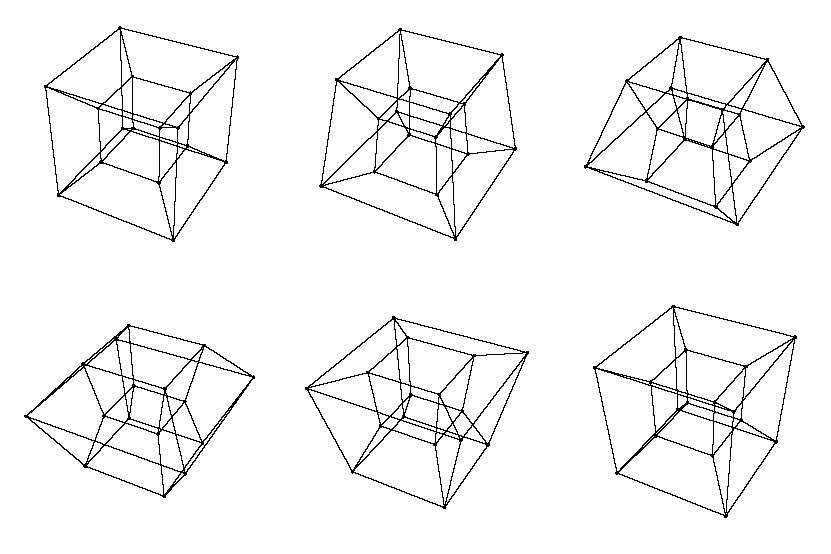
 Hypercube (1888): Charles Howard Hinton (1853-1907)
I don't know any mathematical subject which has intrigued children as well as adults such as the idea of the fourth dimension, a spacial direction different from those we already know in our every day tridimensional life.
Mathematicians and physicists often use the fourth dimension in their calculations. It is part of some important theories which describe how our universe is constructed.
The hypercube is analogous to the ordinary cube in three dimensions. Sometimes is used the term "Tesseract" to name the hypercube of four dimensions.
As well as a cube may be visualized by "Sliding" a square to the third dimension and observing the shape that the square leaves behind in space, the hypercube is generated by the trace of a cube which moves in the fourth dimension.
Although it's difficult to see a cube which moves in a perpendicular direction perpendicular to its three axes, the computer graphics allow mathematicians to be able to have an intuition objects of more than four dimensions.
Note that a cube is limited by its square faces ; by the same way a hypercube is limited by its cubic faces. We may note the number of vertices, edges, faces and solids of these kind of objects :
Vertices Edges Faces Solids
Point 1 0 0 0
Segment of line 2 1 0 0
Square 4 4 1 0
Cube 8 12 6 1
Hypercube 16 32 24 8
The word tesseract was first used in 1888, in the book "A new era of thought" of the british mathematician Charles Howard Hinton. Hinton, who was bigamous, was also famous for the invention of a set of colored cubes, which, he assured, could be used to see in four dimensions. Hinton's cubes were even used in sessions of spiritism, believing that they could facilitate the contact with the dead. - Maths in English Hypercube (1888): Charles Howard Hinton (1853-1907)
I don't know any mathematical subject which has intrigued children as well as adults such as the idea of the fourth dimension, a spacial direction different from those we already know in our every day tridimensional life.
Mathematicians and physicists often use the fourth dimension in their calculations. It is part of some important theories which describe how our universe is constructed.
The hypercube is analogous to the ordinary cube in three dimensions. Sometimes is used the term "Tesseract" to name the hypercube of four dimensions.
As well as a cube may be visualized by "Sliding" a square to the third dimension and observing the shape that the square leaves behind in space, the hypercube is generated by the trace of a cube which moves in the fourth dimension.
Although it's difficult to see a cube which moves in a perpendicular direction perpendicular to its three axes, the computer graphics allow mathematicians to be able to have an intuition objects of more than four dimensions.
Note that a cube is limited by its square faces ; by the same way a hypercube is limited by its cubic faces. We may note the number of vertices, edges, faces and solids of these kind of objects :
Vertices Edges Faces Solids
Point 1 0 0 0
Segment of line 2 1 0 0
Square 4 4 1 0
Cube 8 12 6 1
Hypercube 16 32 24 8
The word tesseract was first used in 1888, in the book "A new era of thought" of the british mathematician Charles Howard Hinton. Hinton, who was bigamous, was also famous for the invention of a set of colored cubes, which, he assured, could be used to see in four dimensions. Hinton's cubes were even used in sessions of spiritism, believing that they could facilitate the contact with the dead. - Maths in English |
